Now that you have
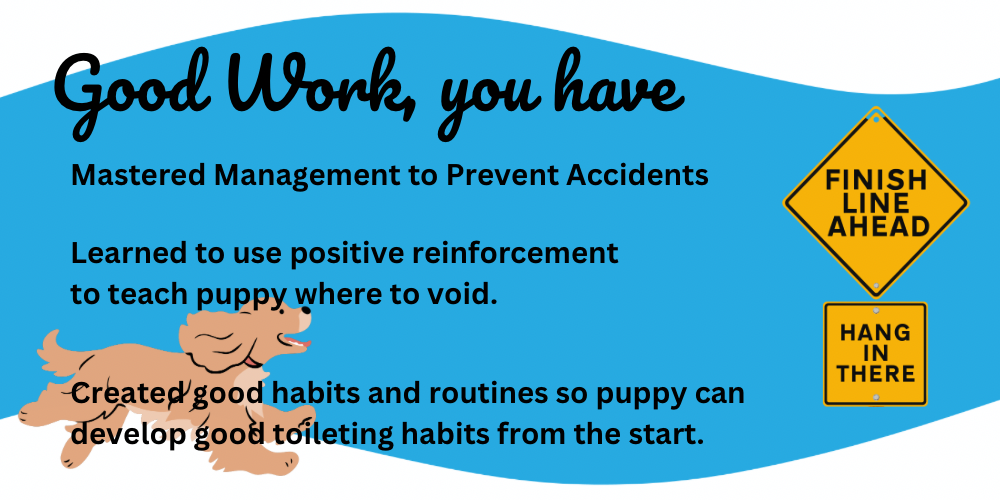
1. mastered management to prevent accidents,
2. positive reinforcement to teach your puppy it’s good to potty outside, and
3. you are creating good habits and routines, you are well on the path to having a house trained young adult.
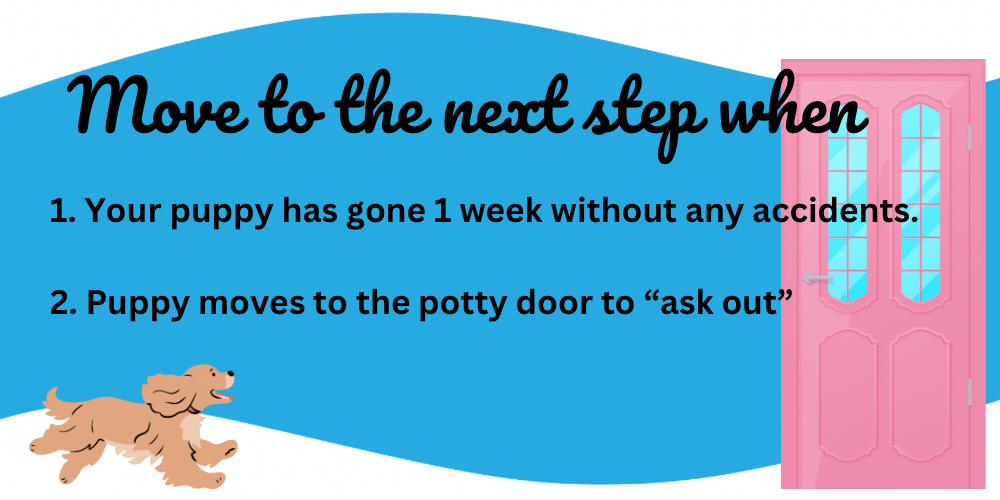
How will you know when to proceed to the next step?
1. Your puppy has gone 1 week without any accidents inside.
2. Your puppy is starting to show you it knows where to go to relieve itself by moving towards the door, or even bumping it’s potty bells to tell us.
When your puppy is one week accident free you can:
1. Expand your puppy’s play area, opening up areas that are further away from the potty door. Resist the urge to open up too much space each week, start with no more than 1 room.
2. Increase duration between potty breaks by 10 to 15 minutes.
3. Start teaching your puppy to ring the potty bells each time you take puppy outside.
Different breeds and individuals mature at different rates, so resist the urge to compare your puppy to other puppies, each puppy is an individual.
✅Once you are 4 weeks into the program,
✅your puppy is going an hour or more between potty breaks, and
✅your puppy is starting to “tell” you that it needs to relieve itself you are ready to move on to the final step.
Before decreasing potty breaks again, be sure that your puppy:
1. Runs directly to the potty door when you move towards the door to take it outside for a potty break.
2. Bonus points if your puppy realizes it needs to potty and it tells you by moving towards the door.
3. Bonus Bonus points if your puppy has learned to ring the potty bells.
At that point your puppy now has a pretty good idea of where to potty, how to find it’s way to the potty zone, and it’s trying really hard to let someone know that it needs to relieve itself.
At this point you can gradually reduce “scheduled” potty breaks to:
📌First morning.
📌After Breakfast
📌At lunchtime
📌Before Dinner
📌After Dinner
📌Before bedtime.
And between those times the Responsible Party will be observing the puppy for any urgent need behaviors, or potty bell ringing.
Be sure to continue supervising your puppy’s potty breaks!
Be consistent in rewarding your puppy for relieving itself outside, use the best treats to reward your puppy for relieving itself on cue.
Be consistent with your “potty before play” routine, and don’t forget the “play” part. As time permits be sure to play with your puppy after it potties. That might take the form of a walk around the back yard, a game of fetch or tug, a training session, or a walk or other outing.
Whichever fun activity you use, have it follow potty time.
Continue to potty your puppy on leash for at least another month. The leash prevents the puppy from running off and making it’s own fun before it relieves itself, it helps ensure that someone accompanies the puppy on as many potty breaks as possible, it furthers leash training, and finally it teaches puppy to go potty on leash (a very important life skill).
As your puppy gets older, and relieves itself reliably on cue, fewer and fewer potty breaks need to be on leash.
Don’t forget to take treats on your walks too, and always reward your puppy for going potty on walks.