At first our puppy won’t be able to hold it long enough, or know how to tell us, it needs to potty. So we will take it out regularly while it figures out those skills, and adds some physical maturity during the first few weeks in our home.
While knowing WHERE to potty is job 1, knowing WHEN to potty is job 2.
In order for our puppy to learn where to potty, it actually MUST potty there, A LOT of times. Habits stem from multiple repetitions of a particular behavior.
Puppies need to void frequently. If we are not diligent our puppy will be forced to potty inside on the floor or carpet, a budding habit!

If we have an indoor litter box and our puppy understands to use it, we have an added safety net because our puppy is likely to make it to the litter box, even if nobody is paying attention.
So,the First Rule of potty club is don’t neglect to watch your puppy!
Create a schedule based on your work schedule, writing down everyone’s schedule. Use this set of schedules to see who is available when.
Puppies need a potty break on average every 30 minutes when they are awake during week 7 and 8 of life. You can add 10 minutes for every week of life.
Every 40 minutes during week 9 and 10
Every 50 minutes during week 11 and 12
Every hour from 3 months on.
However, this is NOT predicable! There are many factors that influence frequency.
This is an average, that includes that a puppy often goes 8 hours at night without emptying it’s bladder, and during naps it’s also no going to empty it’s bladder.
Remember!!!!, if your puppy sleeps 8 hours at night, that does NOT mean it only needs to void every 8 hours. It also doesn't mean the puppy "can hold it" for 8 hours during the day, any more than you could!
Puppies are metabolic freight trains, all that growth means they create more waste than adult dogs. So, yes, puppies actually need to relieve themselves more than adult dogs, as their body processes food into fuel at a manic pace. Their digestive and excretory systems are working harder than they will again. So don’t make the common mistake of thinking because your puppy sleeps and doesn’t void, that it won’t need to void frequently when it’s awake. It’s the opposite actually, all that sleep means that processing waste and eliminating it will speed up during the times the puppy is awake.
Offering frequent opportunities to potty is a foundation of good and rapid house training.
So, get all puppy caregivers together.
Download a timer app, use the timer on your watch/phone/stove/oven or whatever you need to remind each member of scheduled potty breaks. Teach yourself to avoid ignoring or turning off your timer!
And follow these “When Does Puppy Need A Potty Break” rules.
Week 1: Approx 8-10 weeks of age.
Offer a potty break every 30 minutes. RUN or walk quickly with your puppy from it’s location to the toilet spot EVERY TIME during house training!
Do NOT wake Puppy up for a potty break unless you know you must leave the puppy alone (so, before you leave the puppy in it’s crate/pen).
Offer a potty break EVERY time the puppy: Wakes up from sleep, has been running about playing, starts sniffing the ground, starts circling, or runs for the back door regardless of the last potty break.
If you decide the puppy’s need is URGENT, pick the puppy up and carry it to the back door, then set it down in front of the open door and go to the potty spot with your puppy.
Week 2: Approx 9-11 weeks of age. Same as week one except.
Offer potty break every 40 minutes unless your puppy has had an accident. If your puppy has had an accident delay decreasing potty break frequency by 1 week.
Offer a potty break every time your puppy: wakes up from sleep, starts circling or indicating need, OR runs towards the back door.
If the need is urgent carry puppy to open door.
Week 3: Same as week one except.
Offer a potty break every 50 minutes.
Offer Potty break every time your puppy: Indicates needs, moves towards back door.
If need is urgent, and puppy is close to back door, do not carry it, run with it to potty spot instead.
Week 4: Same as week one except
Offer a potty break every hour.
Offer a potty break every time your puppy asks out by moving towards back door (or ringing bells)
If need is urgent run with your puppy to back door.
In all cases if you have had accidents in the house, delay moving to the next weeks work by 1 week.
Do not make changes to the house training plan if your puppy is having accidents inside. Instead, look back over why these accidents are happening, and adjust the schedule, reminders, management to help the puppy be successful.
Pro Tips:
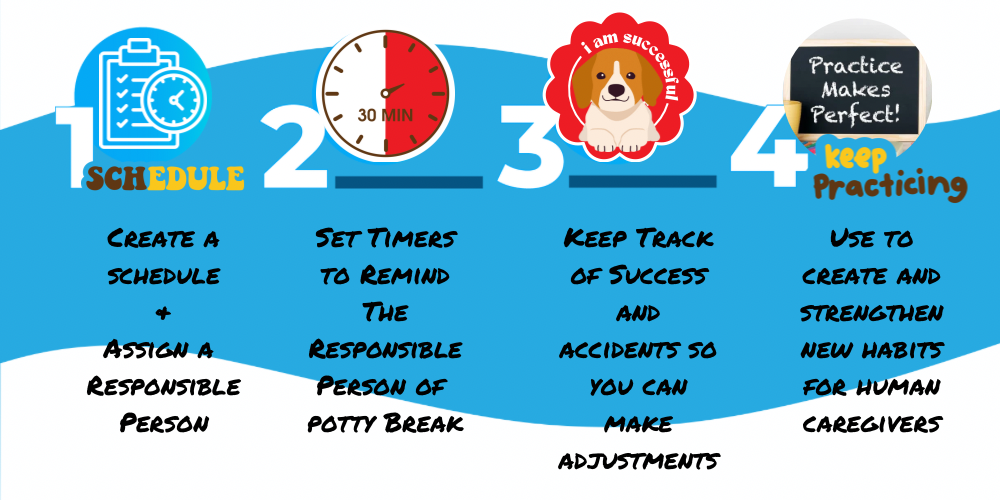
1. Create a schedule, define 1 Responsible Party for each time of the day when the puppy is supervised (ie when someone is home). Do NOT leave people guessing “who is watching the puppy”!
2. Set timers to remind the Responsible Party that a potty break should be offered. We set a timer that the whole house can hear for every X number of minutes.
3. Track Success! Print the Human Success Station and post it by the back door. Assign one color per Responsible Party, and always mark on that day’s paper when the puppy was taken out and by whom.
4. Create a habit for the humans: Timer triggers offered potty break and a mark on the tally board. Puppy frantically circling or sniffing = potty break and mark on the tally sheet, Puppy moving towards back door = Potty break, and finally accidents are marked by time/who the Responsible Party was and location (if things are going well this will stay blank!).