

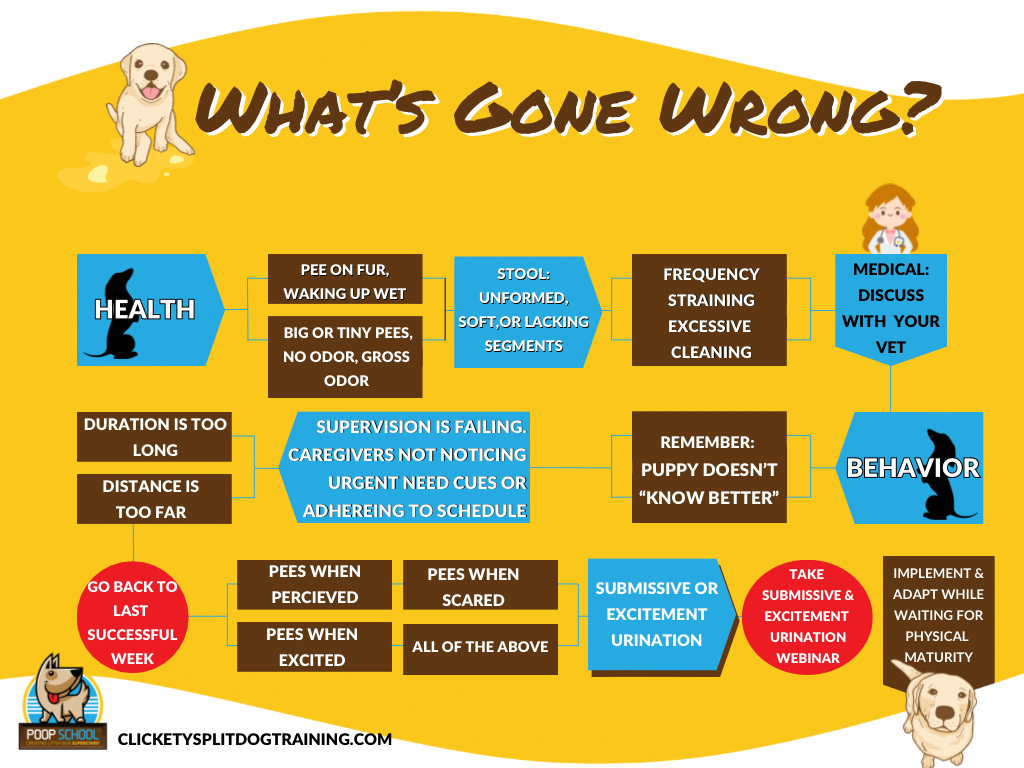
Few puppies are ever house trained without a few unfortunately located puddles and poos. While accidents are unfortunate, and should not be occurring regularly, don’t sweat one or two accidents. However, if a pattern of accidents is occurring act sooner rather than later.
First, remember, when puppies relieve themselves in undesired locations they are behaving in a totally natural way. It’s our demands that are foreign to the puppy! Dogs do not share our revulsion for body fluids, they think pee and poop are great. So, don’t blame your puppy for accidents, but also don’t let them continue, because accidents are habit seeds just waiting for the right conditions to take root.
Remember,
Your puppy does not “know better”
Your puppy is not spiteful,
Your puppy is not “dominate”
Your puppy IS being a dog, and a baby dog at that. Ideally, if you follow the plan, you won’t have any accidents at all. If you have no more than 1 accident per week you are OK, just continue with the plan.If you are having more than 1 accident per week you need to figure out why!
Here are the most likely reasons that are not covered in the previous course materials.
Supervision has failed: This is the most common reason that puppies have accidents inside. Usually, because the Responsible Party has become distracted with another activity and failed to notice the puppy’s urgent need cues, movement towards the potty door, and so the puppy has relieved itself inside. The solution is to ensure the Responsible Party is paying full attention to the puppy. If urgent need behaviors occur, and the puppy is far from the potty door, pick the puppy up and carry it to the potty door.
Duration between offered potty breaks is too long. Answer, go back to last week’s duration. Do not extend the duration between potty breaks unless the puppy has been 1 week accident free.
Puppy’s play space is too far from the potty door. The reason we have Week 1s primary play space as the room closest to the potty door is partially so the puppy can start to learn the route to the potty door. Additionally, the younger a puppy is the less “lead time” the puppy has to relieving itself. So, if your puppy finds itself realizing it needs to potty, but being too far from the potty door it may not physically be able to make it to the door in time. The answer is to make the primary play space closer to the potty door and avoiding expanding the play space for a week while the puppy grows up.
Puppy is voiding in the crate/x pen. If the puppy is voiding in the crate or x pen we need to consider why. Perhaps the puppy is not being offered a potty break before being confined? Is the puppy suffering from confinement distress? If a puppy is uncomfortable with confinement it may be relieving itself because it’s distressed. Is the puppy going potty because it’s simply being confined for a longer amount of time than it can hold it’s bowel and bladder?
Puppy has become unable to hold it’s urine. If the puppy is being confined longer than it can hold it, the answer is to provide either more potty breaks, or provide the puppy with a litter box in the x pen, so that the puppy has an acceptable place to potty when confined.
Puppy Cannot hold bladder or bowels. It is possible the puppy is simply unable to hold its urine or bowels. The most common reason for this is because the puppy is developing a urinary tract infection. Puppies, especially female puppies, are prone to urinary tract infections because their immune systems are immature, their physical structure invites infection (inverted vulva) and they have not yet had the heat cycle needed to change that, and/or they are often confined. To keep a bladder healthy the puppy needs to pee regularly, otherwise pathogens have a chance to sit in the bladder and multiply. So if a puppy is confined 8 hours at night, and 8 hours during the day that is a lot of opportunity for pathogens to multiply and a puppy’s still immature immune system can’t always keep that in check. So, frequent potty breaks and Free Access To Water At All Times is very important to overall health of your puppy.
So, if your puppy:
Is Urinating more than once per hour, Is straining to urinate, Is urinating many large puddles, If the urine smells bad, or conversely, doesn’t smell like urine at all, If the urine is dark, bloody, or clear as water you need to take your puppy to the vet along with your potty log and a fresh pee sample, and just make sure the puppy isn’t suffering from a urinary tract infection or other urinary problem.
If your puppy seems to urinate in their sleep, or if their butt end frequently smells like urine, a vet check is also important. There are birth defects that can cause improperly formed internal structures to drip urine outside of puppy’s control. Diagnosing and correcting an ectopic ureter early is vital. Healthy puppies do not leak urine in their sleep, so if you notice urine stained bedding and puppy’s back legs seem to smell like urine a vet visit is important.
Your breeder or vet can tell you if your breed, or particular puppy, is prone to urinary problems.
Further: If your puppy has Diarrhea, Formed but soft stool, Is straining to defecate, Has blood or mucus in it’s stool, Is producing voluminous stool, Is producing stool that doesn’t smell “right”, Is pooping more than 4 times per day (usually once per meal, once early morning, and evening). Your puppy also needs a vet check, because your puppy may be struggling with gastrointestinal upset due to parasite activity (normal and to be expected in puppies), dietary indiscretion, pathogen, or other GI issues.
While healthy puppies DO pee and poop frequently, If you suspect that your puppy is struggling at all to hold it’s bladder and bowels, don’t discount your puppy is unwell. Puppies are prone to a variety of typical puppy illnesses and these can make house training impossible until diagnosed and treated. So, only try to house train a healthy puppy, an unwell puppy needs time to get well before we expect it to control it’s body functions. If your puppy is diagnosed with anything that can affect it’s house training. Go back to Week 1 work, frequent potty breaks, play space near the potty door, and consider an indoor toilet area near the potty door for urgent need use. Don’t worry, once your puppy is feeling better you can start progressing again!