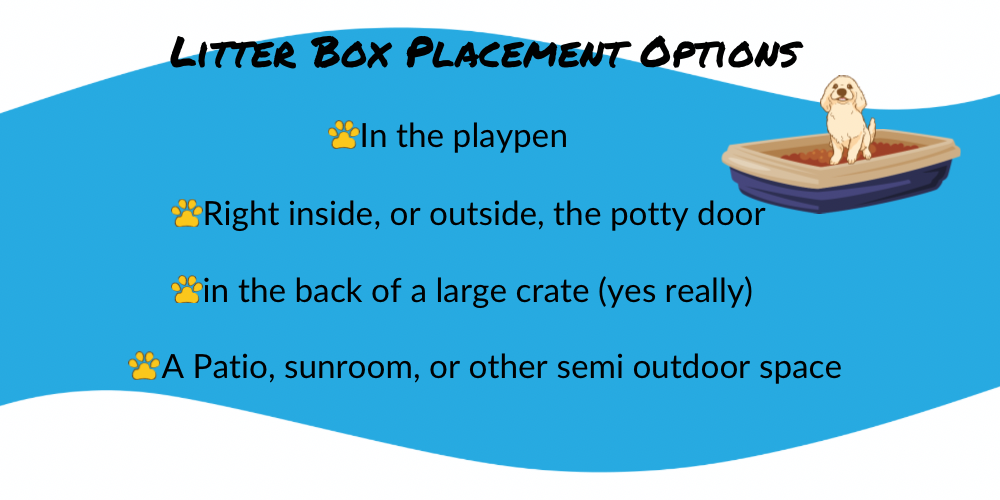
Whatever the reason, teaching your puppy to use a litter box is much the same as teaching it to use an outdoor area. If your breeder was already using a litter box with the litter this process will be super easy, you will only need to teach the puppy where the litter box is located and how to find it, as they are already accustomed to using it.
Size:
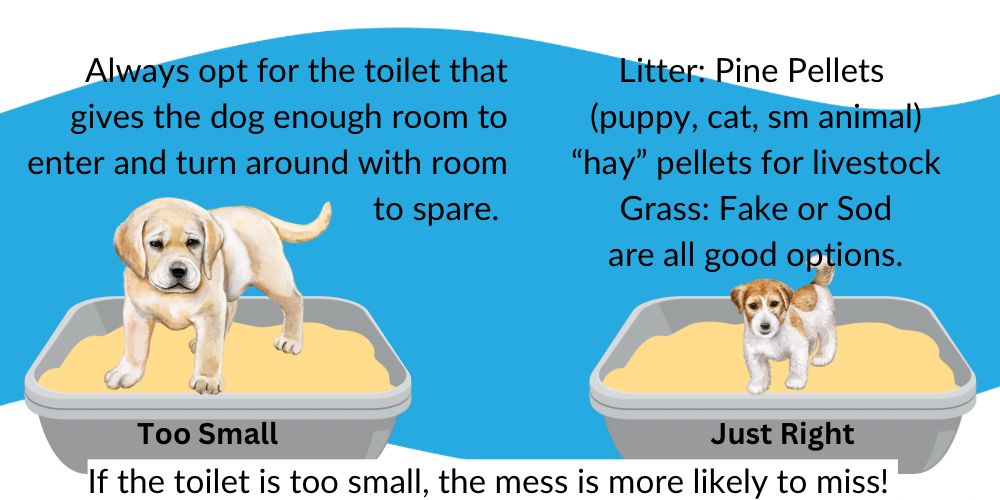
The biggest reason for litter box dissatisfaction is the dog “missing” the litter box. The solution is to ensure the litter box is big enough. For this reason many commercial litter boxes for dog are too small for medium and large breed puppies and lead to frequent misses or refusal to use. The dog needs to be able to comfortably enter, turn around, and position themselves inside the toilet, if they can’t do this easily they will end up “butt out” and miss or even refuse to use the box because they don’t like to bump up against the sides.
A good rule of thumb is your litter box should be at least one and a half times the length of your dogs body. So if your dog is 12 inches from nose tip to tail tip, your litter box should be no smaller than 18 inches square. If your dog is 24 inches from nose tip to tail tip, your box should be a 36 inches square. It’s important that your dog can fit comfortably entirely in it’s litter box, including having room to turn around and position itself. Always err on the side of a larger box. Many items from under bed storage tubbies, to kiddie pools can be used.
Substrate:
If your dog is a “dual” toilet dog, meaning you want them to void outside on grass, and inside the litter box, than the ideal substrate for your litter box is grass sod. Sod toilets can be purchased online as a subscription product, and in the summer sod can be purchased at most home improvement stores. Sod has a limited life and is difficult to clean, so be sure to change it regularly.
Another option would be synthetic grass systems. Fake grass can be used indefinitely but it must be cleaned frequently which requires either a hose for washing it outside, or a way to wash it indoors in the tub or sink, not super fun.
Third choice would be pellet litter, pet stores sell puppy litter for this purpose, and large animal stores like Tractor Supply sell livestock feed hay pellets as Alfalfa, Timothy, or even Beet Pulp pellets and those all work very well a puppy litter and are budget friendly. Some cat litter pellets are non clay, like paper or pine pellets and those work well. Be sure to get a litter scoop for removing soiled litter without changing the entire box out so litter lasts a little longer. Still, even with daily spot cleaning the full box will need to be cleaned out every couple days for a larger puppy.
Last choice is any type of fabric, including disposable and washable potty pads because continual use of fabric as a toilet can lead to dogs who seek out and relieve themselves on fabrics believing fabric to be where they are supposed to go. But in a pinch or for teaching a puppy how to use a box, pee pads work well. Transition to a different type of litter slowly.
Set up:
Ensure your litter box area is extremely “distinctive” so your dog does not wonder if other areas are also toilets.
This means that pads on the floor are not an ideal indoor toilet, they are not distinctive and to the dog seem very much like a towel or rug on the floor.
I like litter trays, such as those made for dogs, or even better for their larger size, rabbit hutch pans, pans for under washing machines, short side storage tubs, small kiddy pools, and for very small puppies boot trays work well. Sides high enough to keep mess in, without making it difficult for your puppy to get in/out are helpful too. Enough room for your puppy to enter and turn around comfortably, even in a couple weeks.
Inside the pan you can put your square of sod, litter pellets, or even shavings depending on your preference. Under the pan you can put something to protect the floor, waterproof mats work well.
Further, if you put a “surround” on three sides you will make the area more distinctive and decrease the chance the puppy will learn to potty “half in and half out” of the toilet. I use X Pen panels around 3 sides of mine. You could use any type of little fence, or plastic panels. The x pen has the benefit of being able to be closed, so you can put the puppy in, close the door, and have a formal potty break which really helps teach the puppy to use the toilet well, instead of just hoping the puppy “finds it” and knows what it’s for.
For male dogs (especially adults) you can put a brick, stone, or PVC pipe upright in the middle of the litter box for male dogs who would like to mark. To ensure they don’t lift their leg and pee outside the box. Again, it’s important the litter pan is large enough for a male dog to lift its leg and urinate on your center post If you are using this for an adult male.
Training:
You will train your dog to use the litter box in the same manner used to teach them the outside potty zone.
Simply substitute “litter box” for “potty zone” in all instructions.
The litter box is open to the puppy all the time, so you don’t need to teach the potty bells step unless you know you plan on removing the box eventually and prefer the dog learns to tell you when they need to relieve themselves.
You can put your puppy on leash, or, if you use an x pen to surround your litter box you will simply place the puppy in the litter box, close the “gate”, and stand their and wait for the puppy to relieve itself.
Yes, you DO need to take your puppy to the litter box on schedule.
Yes, you DO need to stand nearby and watch the puppy!
Yes, you DO need to teach your puppy to void on cue, and click/treat for every successful potty.
However if you leave the box open of course your puppy can go in and void whenever they need to, be sure to watch for this and reward your puppy for making a good choice!
I find that people often skip the steps of teaching a puppy how to use an indoor toilet, they think they can just let the puppy run all around and figure things out. But the problem with that is that since the toilet is inside the house, it’s actually less clear for the puppy, and many poorly trained litter box dogs are just not really house trained at all.
This is even more important for dogs with a history of house soiling because of course you are battling a very long learning history of voiding indoors and all the ”behavior baggage” of what that dog has learned over time.
Don’t make the mistake of thinking the dog will just “figure it out” if it’s not done properly the puppy may become confused about where it should relieve itself.
Remember, puppies who learn to use an indoor toilet still need to learn to void outside, on leash, and in novel environments to prepare them for life.
They also need to learn that ONLY the toilet is for toileting, they need to learn how to find the toilet area, and how to use it when asked.
WE also need to know when a puppy has relieved itself and when it has not, for our own house training planning.
So, be sure to follow the plan and teach the dog the necessary skills, even if you plan to use the box long term.