

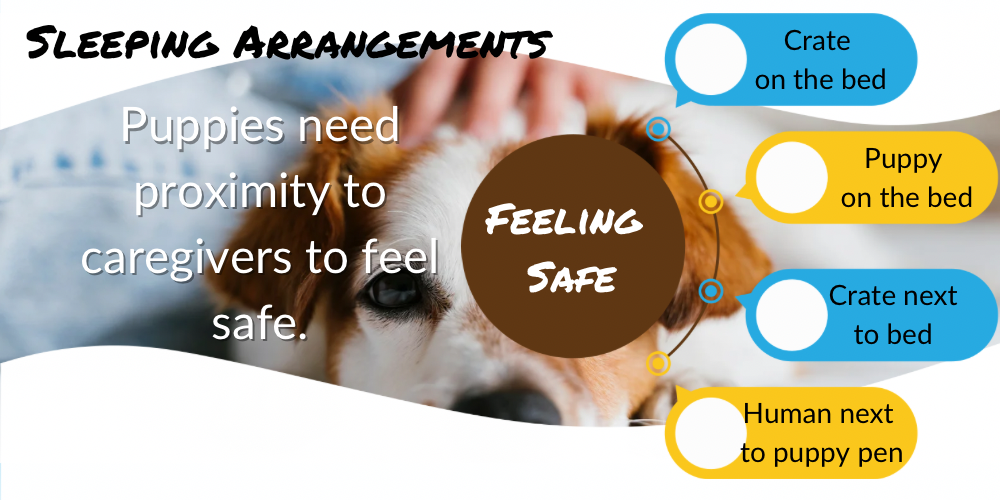
How to handle puppy sleeping arrangements varies based on factors unique to your home. Here are some things to consider as you devise sleeping arrangements for your puppy.
1) Ideally puppies should sleep in the bedroom very close to a person who is a light enough sleeper to wake up of the puppy becomes restless in the crate.
2) Children are not suitable for overnight monitoring of puppies, they sleep too deeply and may not be able to follow proper potty procedure.
3) The crate should be placed very hear the head of the bed, either on the bed itself (if the crate is small enough, and the bed large enough), or directly beside the responsible person until the puppy is sleeping through the night well. Then the crate can gradually be moved to another spot in the room.
4) Puppies crated on the floor should have their crate elevated on a table or other secure platform at first to raise them up so they can sense the close proximity of their humans. This can prevent most separation distress vocalization during the night.
5) As the puppy sleeps through the night consistently, and approaches three to four months, the crate can be moved off the platform onto the floor, then gradually moved further away from the bed to it’s permanent location, keeping in mind that many breeds will be happier being able to sleep near the family and not isolated in a different room of the house, especially if there is not housemate dog to keep them company.
6) The nighttime crate can be smaller, and replaced with a full size crate when the puppy is around 4 to 6 months old. In some cases it may be warranted to use a litter box in the nighttime crate. This will allow the puppy to relieve themselves in the night without waking the household. This can be especially helpful for puppy brought home very young (under 8 weeks), puppies who don’t wake their owners up when they need to void, puppies with UTI or other health reasons for frequent urination or diarrhea, or in homes where nighttime waking is undesirable.
7) This course does not address crate training or crate conditioning directly, but these are vitally important skills. Please see our Crate School course if you need help crate training your puppy.
Ideally you will decide before your puppy arrives how you are going to set up sleeping arrangements for your puppy. If your puppy will not arrive to you with any crate training it may be advantageous to crate train the puppy BEFORE you sleep the puppy overnight in the crate.
In this case, your puppy will need to sleep in the x pen, and the responsible person will need to sleep next to the puppy on a cot, sofa, or mattress. This will prevent them puppy from experiencing separation distress as it adjusts to being separated from the litter, and allow for potty breaks during the nighttime. For those who are light sleepers the puppy can also sleep in the bed with a waterproof blanket down in case of accident.
Once the puppy is crate trained it can move to sleeping in the crate.
If the puppy will never be allowed in the bedrooms then the responsible person will sleep next to the puppy throughout transition week and until the puppy is sleeping through the night, moving a few feet further away each night (after transition week) until sleeping in their own bed again. But do NOT leave the room the puppy is sleeping in until the puppy is able to sleep through the night in a crate, otherwise you might sleep through the puppy waking up and needing to relieve itself, forcing the puppy to potty in it’s crate.